


Laid Off is the coolest place on the internet to talk about being laid off. Have a tip or juicy story? Hit reply.
For the next Laid Off trend report, I want to hear about the state of the job search. I also snuck in a free invite to the Laid Off Discord for anyone who takes it within the next few days.
In today’s issue, I talk to a former technical writer on what it actually takes to build an audience and make real money in the adult content space.
Back in April, I published a trend report on how people actually made money after a layoff. One story I wanted to go deeper on was from someone who’d been creating adult content with his wife for years, and whose side income became a lot more important after he lost his job.
Most people know what OnlyFans is by now, and platforms like it are hardly new ways to make money. And I feel like we’ve all heard some version of the aside, “Maybe I should just sell feet pics,” when talking about ways to make some quick cash. But there’s a lot more that goes into actually making money in the adult content space than simply creating an account and posting photos. Beyond creating the content itself, you also have to be a marketer, a social media manager, a promoter, and figure out how to find an audience in an increasingly crowded market. Making some extra money is one thing. Making enough to replace a full-time income is another.
So I reached out to Craig, 37, who lives in Central California, to learn more about what that actually looks like in practice.
Craig was working as a technical writer when he was laid off in May 2024. He first realized something was off when he couldn’t get into Slack. His work email was still active, but when he checked it, there was a message informing him he’d been laid off. The company cited “restructuring” and left it at that.
He received less than three months of severance, had no emergency savings, and his biggest financial concern was keeping up with his mortgage. He and his wife did have another source of income they’d been building long before the layoff: the two had been creating adult content together since before they were married, with a focus on 3D VR porn. Rather than relying primarily on OnlyFans, they’ve found more success on VR-specific streaming sites.
OnlyFans is actually a much smaller part of their business. Craig says the platform has become so saturated that even putting in a ton of work doesn’t guarantee you’ll make much money. Their niche in VR, which relatively few creators are working in, has been a more reliable source of income.
Craig and his wife both pole dance, and he also recently designed and started selling a pole-leveling tool that makes it easier to check whether a pole is straight during installation. And he’s been slowly growing a local home repair business.
Today, his wife still has her full-time job, and Craig’s home repair business has grown enough that their combined incomes can support them. The adult content and pole-leveling tool are still what he calls “side hustles,” though they relied on that income more when he first lost his job. These days, he says, they mostly provide “some play money.”
Take me back to when you first started making adult content with your wife.
It started more than a decade ago, before we were married. At first we were just posting for fun, and over time we built a pretty decent following, around 12,000 followers on Twitter. We eventually stepped away from it for a few years, but when OnlyFans became popular, we thought “We’re already comfortable doing this, why not see if we can make some money from it?” So around early 2023 we started taking it more seriously and monetizing it, and then around early 2025 we added VR content. We make way more from the VR content than we ever did on OnlyFans. Initially it was always just extra fun money. When I got laid off, there was a brief period where it became a more meaningful source of income, but fortunately my handyman business took off, so we never really had to fully depend on it.
How soon after getting laid off did you start thinking about it as a meaningful source of income?
It wasn’t until we started making VR content where it became more “oh this is actually meaningful income rather than just beer money.” OnlyFans is saturated and it’s really hard to get an audience. There’s a lot of marketing and promoting involved to get people to subscribe to your OnlyFans. With VR content, we post on a couple of VR adult sites that already have big audiences ready to buy and watch.
You went from working as a technical content writer to making and selling adult content. Did that feel like a major psychological shift to you, or did it feel more natural than someone on the outside might assume?
I guess I would phrase this more of “I was working as a technical writer while also making and selling adult content.” But to answer the question, it never felt weird and always felt natural, mainly because we’ve always been sex worker positive, and our circle and community of friends are sex worker positive. We have several close friends who also create and sell adult content.
Was there anything you had to get over — or rethink — before you felt comfortable making money this way? I’m thinking about privacy, stigma, what former coworkers might think, family finding out, having your image online, etc.
The biggest privacy concern for us isn’t being judged personally. In other words, if someone found out and simply thought what we do was weird or inappropriate, that wouldn’t really bother us. What concerns us is how someone might use that information because of the stigma surrounding adult content. For me, it could affect my business if someone publicly exposed what we do and tried to discourage people from hiring me. For my wife, it could potentially have serious consequences for her job or even her broader career. So our anonymity is less about embarrassment and more about protecting our livelihoods and preventing something we do privately from being weaponized against us professionally.
If you rewind all the way to day one: you decide, “Okay, let’s try making money from adult content.” What did you actually have to do next? Where does someone even begin?
There were a lot of questions we needed to answer that we never really thought about when we were just doing it for fun. We had to choose platforms, create accounts, go through age and identity verification, figure out how much we were going to charge, and decide what kind of content we wanted to focus on. We had to think more about things like keeping our identifying details out of certain content. For example, I don’t mind showing my full face and my wife wears either sunglasses or a masquerade mask, but we have couch pillows with the name of our town on them, so we have to make sure they’re flipped over when we record.
Then there’s the business side that you don’t really think about at first: promoting yourself, figuring out what people actually want to see and what they’re willing to pay for, keeping up with posting, and eventually dealing with taxes, consent forms, and 2257 record-keeping. There wasn’t really a moment where we suddenly became “content creators.” It was more like gradually realizing there were a lot of little pieces involved if we wanted to turn something we were already doing for fun into something that actually generated income.

What did it cost to get started? Did you need cameras, VR equipment, lighting, editing software, platform fees, anything else?
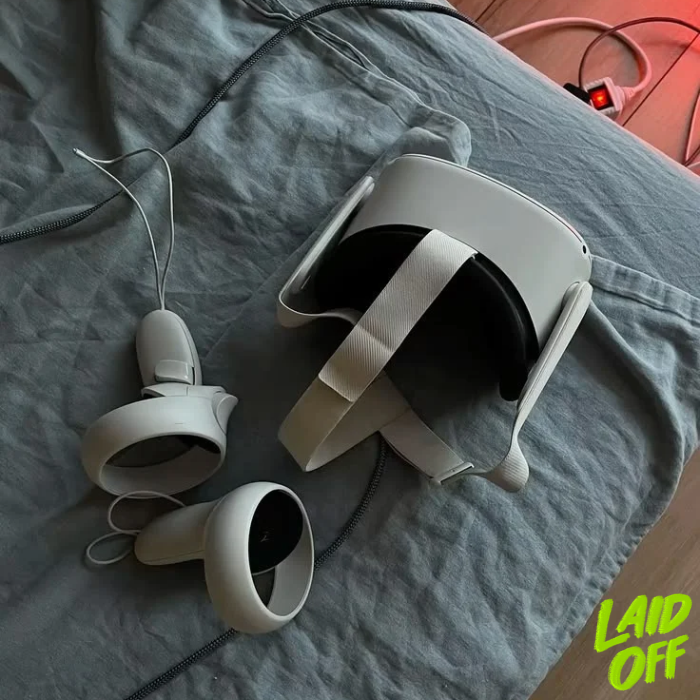
There’s definitely a financial barrier-to-entry to creating VR content, but also it’s who you know and how much research you do. That’s also probably why VR content does so much better for us than OnlyFans, because there just aren’t a lot of creators doing VR. A professional VR camera rig is $5 to $6K at the absolute cheapest. However, you can get consumer-grade VR camera rigs for around $1,000 if you know where to look, because they actually don’t exist in the retail market. The only way to get a consumer-grade VR rig is by modifying a retail 360-degree action camera into a side-by-side 180-degree VR camera. If you have a lot of electronics knowledge, you can do it yourself, but I found someone who does this service, and he’s the only one doing it as far as I know. Other than the camera, we have about $200 in tripods, $150 in microphones, $300 in lights, $20/month for Adobe Premiere. So in total, around $1,700 in start-up costs. That’s not a lot at all. But again, you need to know how to use the VR camera and how to properly film in VR. Spoiler: it’s a completely different beast than traditional video.
I think a lot of people hear “making money from adult content” and immediately think OnlyFans. But you told me OnlyFans is actually a pretty small part of your income. Where does the money come from for you, and how do those different platforms pay creators?
OnlyFans is just so insanely saturated that it takes a ton of effort and time to promote yourself and get people to subscribe to yours. It’s possible, but it’s an uphill battle, and you have to put in the work, which can feel like a full-time job on its own. Because VR is such a unique technology, not very many creators are doing it, so it’s a lot easier for us to get in front of VR consumers. The audience is already there waiting for us in a sense. Right away we started making way more money from VR content than OnlyFans, to the point that we basically just started to ignore our OnlyFans and focus only on VR. OnlyFans takes a 20% cut of all your sales, whereas the VR sites use a revenue share model. In other words, we get paid based on how many views, likes, and rewatches our VR videos get. It’s very similar to YouTube’s model for paying its creators.
You said OnlyFans is extremely saturated. What did you learn about the difference between simply putting content online and actually getting people to pay for it?
You can have good content sitting on OnlyFans, but if nobody knows you exist, it doesn’t matter. There’s so much competition that simply creating an account and posting regularly isn’t enough. You have to promote yourself somewhere else like Twitter, Reddit, Instagram, etc, and those platforms are increasingly hostile to sex workers. Unfortunately, we lost our abandoned Twitter account, so we had to start from scratch. From there, you have to give people a reason to leave a place where they can see endless free adult content and actually pay for yours. This is where we learned that people aren’t necessarily paying just to see nudity or sex. They’re often paying because they like a particular creator’s unique look, personality, niche, or authenticity. So it became obvious pretty quickly that it’s really a marketing business. You’re constantly trying to get attention, build an audience, establish some kind of connection or identity, and then convert a small percentage of those people into paying subscribers. The content is the product, but getting people through the door is an entirely different job.

How much of the job is actually making adult content, and how much is all the other stuff — marketing, answering messages, figuring out platforms, watching analytics, editing, bookkeeping, coming up with ideas?
Marketing and promoting is 80% of the job if you do use OnlyFans. For our VR content, I’d say it’s 50% creating the content because filming VR is much more involved than traditional video, 30% editing, and 20% everything else like uploading, analytics, bookkeeping, record-keeping, etc. There’s really no marketing involved because the audience is already there waiting to watch when we upload to the VR sites.
Can you give me a sense of the economics? What might one piece of content earn, what does a good month look like versus a slow one, and how unpredictable is the income?
We’ve been creating VR content for about a year and a half now, and we’ve made a total of around $7,000 in that time. The last couple of months we’ve averaged around $750/month, compared to $200-$300/month during the first year or so. It’s really not that much in the grand scheme of things, but since we didn’t need to fully rely on that income for very long after I got laid off, we’ve been able to use that money for our vacation fund. It’s unpredictable though. We never really know if a certain video will go viral or not.
For someone who got laid off and is genuinely thinking, “Maybe I could make money doing this,” what would you want them to understand before they start — both about the money and about the reality of putting sexual content online?
Adult content is not easy money. Everyone jokes that it is like, ”damn, maybe I should start taking feet pics and post them on OnlyFans.” You assume that if you make good content and put it behind a paywall, people would eventually find it and pay for it. What a lot of people don’t realize is how much of the job is actually marketing. You can spend hours creating content and still make very little if you don’t know how to build an audience and convince people to pay when there’s so much free content available. But my biggest piece of advice? Pick a specific niche, kink, or fetish and go all-in on it. We have close friends who create giantess content and they average around $10K/month.
Honestly, though, I wouldn’t recommend someone who just lost their job look at this as an immediate replacement for a paycheck. Again, it takes time to build an audience, and there’s no guarantee it will ever become substantial income. It only worked for us because we were already creating adult content when I got laid off. The last thing is that once your content is out there, you have to assume you may eventually lose control of it. Even if you’re careful about privacy, your content can potentially be connected back to you. So before starting, you really need to ask yourself whether you could live with the possibility of friends, family, coworkers, clients, or your employer someday finding out.

Craig is open to work if you’re looking for an adult content producer, or you already create adult content and want to start producing VR content. On the more SFW side, Craig’s handyman business is doing really well, but he misses technical writing, project management, and operations management. Hit him up at helloitscraig@protonmail.com

There’s no big operation behind Laid Off. It’s just me, talking to people about work, layoffs, and everything they tend to unravel — or reveal — about the rest of our lives.
If you like what I’m doing and want me to keep doing more of it, consider becoming a paid subscriber. It’s $5/month, and you’ll get an invite to the Laid Off Discord, too.
More from the Laid Off universe…


Love this detail into the amount of work that adult contact creation takes as so many people do consider it as an easy option after being laid off after being laid off
Really hard to make it on any side hustle, there is little money and everybody is doing it, a lot of competence out there for everything.